
The two hemispheres of the brain — the left and the right — are almost mirror images of each other in appearance and are separated by the corpus callosum, which enables communication between both sides.
Arguably, the left hemisphere is the more complex of the two. It contains regions responsible for speech and language comprehension and is strongly involved in forward planning, reflective thinking, and placing value and meaning on our experiences.
By contrast, the right hemisphere is generally considered the more reactive side. It plays a major role in how we experience sensations such as anxiety, fear, and pain. The left hemisphere then contributes by interpreting and rationalising these experiences as important or not.
In some respects we could say that the right hemisphere can amplify experiences through positive feedback, while the left hemisphere provides stabilising negative feedback that helps settle the system again.
However, the real goal is not about being positive or negative — it is about being centred. A centred system allows us to transition between different states of experience smoothly and efficiently.
When I treat people with complex psychophysical diseases and disorders, I almost always observe a form of hemispheric dominance, either left or right. By far the most common pattern I see is right-hemisphere dominance. Many of the patients arrive after extensive conventional rehabilitation has failed to produce meaningful improvement.
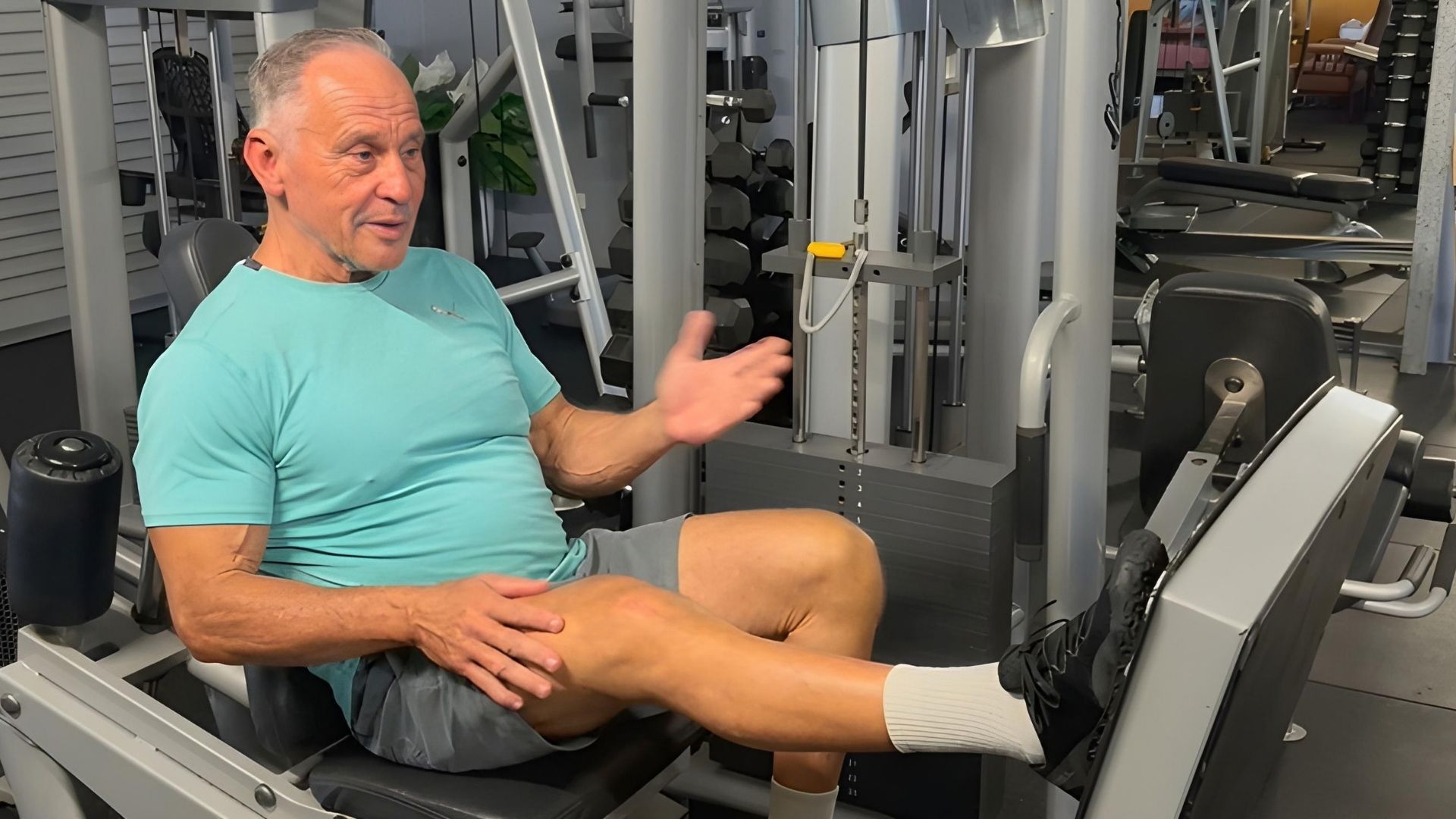
In terms of recovery, the lateralisation of the hemispheres becomes critically important. Within NeuroPhysics Therapy (NPT), we utilise several unilateral resistance exercise machines with the patient performing each movement slowly and deliberately, with their eyes closed while attempting to remain calm and composed.
This allows for the observation of how each hemisphere is responding to the movement and identify when hemispheric dominance begins to emerge.
Patients gradually become aware of these fluctuating hemispheric influences, which often reflect their default responses to real-world experiences and the psychophysical conditions they are seeking help to overcome.
Over time they learn how to centre their experience across the various machines, acquiring what I refer to as multistability — the ability to function effectively across multiple stable states. As this occurs, renewed stable reference points begin to emerge and normalisation of the psychophysical system can occur within surprisingly small time frames.
Now consider the common encouragement of single-limb resistance exercises.
For many years I have observed health professionals and personal trainers encourage people to perform single-limb movements in an attempt to “balance out” perceived strength differences between one arm or leg and the other, or as part of rehabilitation for an injured limb.
When we perform a single-limb movement, the opposite hemisphere of the brain becomes primarily responsible for controlling that movement. The left hemisphere largely governs the right side of the body, while the right hemisphere governs the left side.
The body below the neck is mapped across the sensory-motor regions of each hemisphere, and the details of injury to a limb are also represented in the opposite hemisphere.
If we repeatedly train one limb at a time, we can begin to alternate between the different perceptual frameworks of each hemisphere. Because each hemisphere interprets sensory information somewhat differently, it can become difficult to determine whether the limbs truly feel balanced. The hemispheres need to cooperate for accurate comparison to occur.
Ideally, we do not want the pendulum of experience swinging excessively between left and right hemispheric influence.
When it comes to injury repair, I have found that the most effective approach is often for both limbs to move slowly through the same plane in a harmonious manner.
This allows the hemisphere containing the detailed representation of the injury to learn from the opposite hemisphere and re-establish a centred experience of movement.
Over many years I have seen remarkable functional improvements in patients with severe asymmetries, including individuals who have survived strokes affecting one hemisphere of the brain.
Then there is the issue of muscle isolation.
The deliberate isolation of stress onto a single muscle group is largely a human concept. In nature, movement is normally integrated, coordinated, and flowing.
Human beings are perhaps the only animal that can lift something with enthusiasm during the concentric phase of a movement and then emotionally disengage during the eccentric phase. Yet this pattern is repeated again and again during many training routines.
Thankfully, it is becoming more common for people to maintain connection and control during both phases of a resistance movement.
When we isolate a muscle group excessively, we may also be hyper-stimulating the associated regions of the brain, potentially compromising the balanced flow of information throughout the system.
Consider the serve of an elite tennis player. The ball is not struck by the arm alone — the entire body participates in the movement. Because the system functions as a whole, athletes can transition between states rapidly and seamlessly, often entering what we call a flow state.
How we deal with stress is how we deal with stress.
So use your exercise program as an opportunity to gradually challenge yourself with greater levels of demand, while remaining calm, composed, and coordinated.
When you practise responding to stress in this way, you develop a capacity that carries directly into your everyday life.
If you found this useful, please share it with others.